
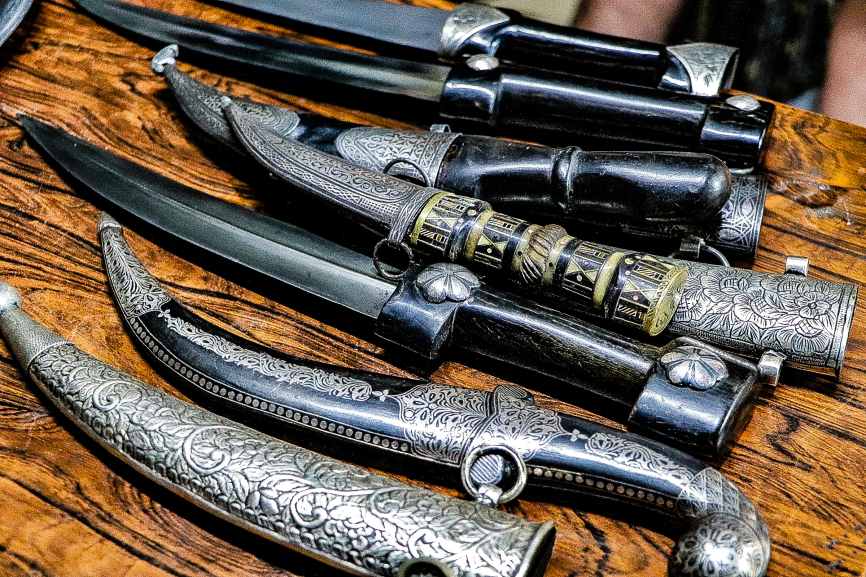
Swords have played a vital role in shaping human history. Among the many legendary blades forged across centuries, two names stand out for their uniqueness, beauty, and battlefield dominance: the Saber Sword and the Damascus Sword. While both are iconic, they differ greatly in design, origin, and purpose. This article explores their history, construction, uses, and lasting cultural impact.
The Saber Sword: Speed, Curvature, and Cavalry Power
The saber sword originated in Central Asia and Eastern Europe, gaining prominence between the 16th and 19th centuries. Its design was influenced by nomadic horsemen, particularly the Turks, Mongols, and Hungarians, who needed a weapon suited for fast, mounted combat.
The saber became especially famous in European cavalry units, where it was widely used by soldiers in countries such as France, Britain, Poland, and Russia.
Design and Characteristics
The saber sword is easily recognized by its curved blade, typically measuring between 70 to 90 centimeters. The curve allows for powerful slashing attacks while riding at high speed.
Key features include:
- A single-edged blade
- A slight to deep curve
- A handguardto protect the user’s hand
- Lightweight design for speed and agility
This design made the saber ideal for cutting rather than thrusting, especially in hit-and-run cavalry attacks.
Combat Use and Effectiveness
Sabers excelled in mounted warfare. The curved blade allowed riders to strike enemies without the blade getting stuck. The slicing motion caused devastating wounds, making the saber extremely effective on the battlefield.
Because of its speed and ease of use, the saber was also popular in dueling and military training. Even today, modern fencing includes saber fencing, inspired directly by historical saber techniques.
Cultural and Military Legacy
The saber sword became a symbol of rank and honor, especially among officers. Many ceremonial military swords today are based on saber designs. It represents discipline, agility, and military tradition.
The Damascus Sword: Mystery, Steel, and Legendary Sharpness
Origins of Damascus Steel
The Damascus sword is famous not for its shape, but for its exceptional steel quality. The name comes from the city of Damascus (modern-day Syria), a major trading hub during the Islamic Golden Age.
Damascus swords were crafted from wootz steel, originally produced in India and Sri Lanka, then forged by Middle Eastern blacksmiths into extraordinary blades between 300 AD and 1700 AD.
Unique Steel Patterns
One of the most striking features of a Damascus sword is its distinctive wavy or water-like patterns on the blade. These patterns are not decorative alone—they result from the internal structure of the steel.
Damascus steel was known for:
- Extreme sharpness
- High flexibility
- Excellent edge retention
- Resistance to breaking or shattering
Legends claim Damascus blades could cut through armor, other swords, or even silk falling in mid-air.
Craftsmanship and Lost Techniques
The original method of producing true Damascus steel was lost around the 18th century. Modern “Damascus” blades are usually pattern-welded steel, inspired by the original look but made using different techniques.
True historical Damascus swords were highly prized and often owned by elite warriors, nobles, and rulers.
Use in Warfare
Unlike the saber, Damascus swords came in many shapes—straight, curved, long, or short—depending on regional fighting styles. These swords were used across the Middle East, Persia, and South Asia in both infantry and cavalry combat.
Their superior quality gave warriors a significant advantage in prolonged battles.
Cultural Significance
The Damascus sword is more than a weapon—it is a symbol of Islamic craftsmanship, scientific knowledge, and artistry. Even today, it is regarded as one of the finest metallurgical achievements in history.
Saber Sword vs Damascus Sword: Key Differences
| Feature | Saber Sword | Damascus Sword |
| Origin | Central Asia & Europe | Middle East (steel from India) |
| Blade Shape | Curved | Straight or curved |
| Main Strength | Speed and slashing | Sharpness and durability |
| Combat Style | Cavalry-based | Versatile (infantry & cavalry) |
| Fame | Military use & fencing | Legendary steel quality |
Modern Use and Collectibility
Today, both saber swords and Damascus swords are popular among:
- Collectors
- Martial artists
- Historical reenactors
- Decorative sword enthusiasts
Authentic antique examples can sell for thousands or even millions of dollars, depending on condition and provenance.
Modern replicas are also widely produced for display, training, and ceremonial purposes.
Conclusion
Both the Saber Sword and the Damascus Sword represent different philosophies of warfare and craftsmanship. The saber emphasizes speed, mobility, and tactical efficiency, while the Damascus sword symbolizes metallurgical excellence, mystery, and timeless beauty.
Though centuries have passed since their peak usage, these swords continue to inspire fascination, respect, and admiration. They remind us that weapons are not just tools of war—but reflections of the cultures, technologies, and values that created them.