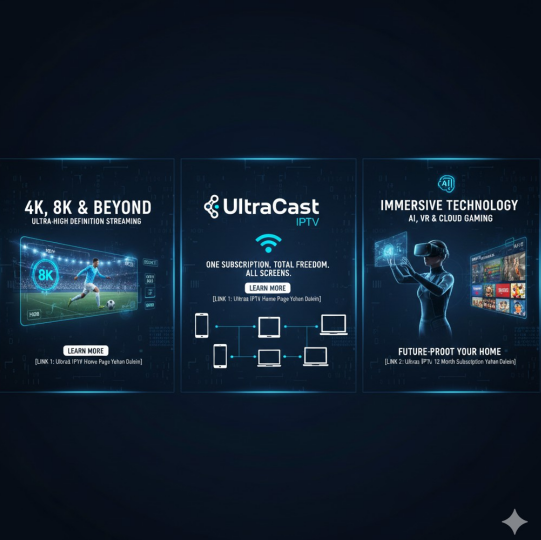
In the rapidly evolving landscape of digital media, the definition of “Television” has undergone a radical transformation. As display technology evolves, the delivery systems must keep pace.
This is where ultracastiptv.com is leading the charge, ensuring that the infrastructure is ready to handle the massive data requirements of 4K, 8K, and the immersive technologies of the future.
1. The Transition from 4K to 8K: Why Resolution Matters
Most modern households have now adopted 4K Ultra HD as the standard. However, the industry is already moving toward 8K. With a resolution of $7680 \times 4320$ pixels, 8K offers sixteen times the detail of Full HD. For the consumer, this means a “window-like” experience where the depth of field and color accuracy create a truly life-like image.
2. Bandwidth and the Challenge of Ultra-High Resolution
The biggest hurdle for 4K and 8K streaming is not the hardware, but the bandwidth. To solve this, advanced IPTV services utilize HEVC (High-Efficiency Video Coding) or H.265. This compression technology allows high-resolution content to be streamed using up to 50% less bandwidth without losing quality.
3. Beyond Pixels: HDR and Color Depth
The future of entertainment isn’t just about more pixels; it’s about better pixels. High Dynamic Range (HDR) and Dolby Vision are changing how we perceive contrast and color. Modern IPTV architecture is now built to support these metadata-heavy streams, ensuring that your 4K HDR TV actually delivers the performance it was built for.
4. High Frame Rates (HFR) and the Sports Experience
For sports fans, resolution is only half the story. The future of sports broadcasting lies in High Frame Rates. Instead of the standard 24 or 30 frames per second, the industry is moving toward 60fps and even 120fps. This eliminates motion blur, making fast-moving objects like a cricket ball or a Formula 1 car look perfectly sharp.
5. Artificial Intelligence and Upscaling
We are currently in a “hybrid era” where not all content is filmed in 8K, but most flagship TVs are 8K ready. The future involves AI-driven upscaling, where the IPTV server or the set-top box uses machine learning to fill in the missing pixels of older content, making classic movies look significantly better.
6. Cloud Gaming and the Intersection of Media
The future of entertainment is “Convergence.” We are seeing the lines between watching TV and playing games disappear. Cloud gaming requires the same low-latency, high-bandwidth infrastructure as premium IPTV. In the coming years, your subscription will give you access to interactive 4K gaming experiences directly through your streaming app.
7. Virtual Reality (VR) and 360-Degree Streaming
Imagine standing on the stage via a VR headset. 360-degree live streaming is the next frontier. This requires a “Multi-Stream” delivery system where the user can change their perspective in real-time, providing a personalized experience that traditional cable can never replicate.
8. Latency and the “Real-Time” Requirement
As we move toward “Interactive TV,” latency becomes a critical factor. The future of streaming is “Zero-Latency.” Whether it’s live betting on sports or participating in a live TV game show, the stream needs to be perfectly synced with the real world in real-time.
9. Semantic Personalization and AI Discovery
With 20,000+ channels, the problem of “Choice Overload” is real. The future involves Semantically Aware AI that understands why you like a certain show. It will analyze themes and pacing to curate a perfectly personalized channel just for you.
10. Conclusion: Securing Your Seat in the Future
The era of compromise is over. As we move into the world of 8K, VR, and AI-driven media, having a forward-thinking provider is essential. Your entertainment system is an investment in your quality of life. By securing an ultracastiptv.com/ultracast-iptv-12-month-1-device , you are future-proofing your home for the next generation of digital reality.